

- Health and Safety Law, Regulation and Influence (H/617/7542) Assignment Brief 2026
- Risk and Incident Management (Y/617/7540) Assignment Brief 2026
- Maintaining a Safe Workplace Environment (R/617/9092) Assignment Brief 2026
- OTHM level 6 Health and Safety Management Practice (Y/617/8526) Assignment Brief 2026
- Development of the Health and Safety Practitioner (K/617/7543) Assignment Brief 2026
- Promoting a Positive Health and Safety Culture (Y/617/8543) Assignment Brief 2026
- Health and Safety Management Principles and Policy (H/617/7539) Assignment Brief 2026
- Unit 4011 Fluid Mechanics (T/651/0724) Assignment Brief 2026
- Unit 4006 Mechatronics (Y/651/0716) Assignment Brief 2026
- Unit 4004 Managing a Professional Engineering Project (L/651/0712) Assignment Brief 2026
- 5CO02 Evidenced-Based Practice Learner Assessment Brief 2026
- Unit 605 Optimising Organisational Capacity Assignment Brief 2026
- Unit 603 Progressive Discourse in Modern Leadership Assignment Brief 2026
- Unit 8360-602 Developing Critical Thinking Assignment Brief 2026
- Unit 601 Developing Personal Effectiveness and Impact Assignment Brief 2026
- Unit 702 Developing and Maintaining a High-Performance Culture and Optimising Resources Assignment Brief 2026
- MDW4102 Physiological Principles of Midwifery Care Assessment 3, 2026
- BEM100L Sustainability in International Business Assessment Brief 2026
- Unit 16 Managing the Customer Experience (H/618/5057) Assignment Brief 2026
- Unit 13 Human Capital Management (J/618/1762) Assignment Brief 2026
Explain the physical importance and give the mathematical definition: Thermofluids, Assignment, UOS, UK
| University | University of Southampton (UOS) |
| Subject | Thermofluids Assignment |
SECTION A
Explain the physical importance and give the mathematical definition of the following non-dimensional numbers related to forced convection.
(a) Reynolds number
(b) Prandtl number
2. In a steady isentropic compressible flow, the following equation can be derived between the cross-sectional area, A, the pressure, P, and the

For subsonic and supersonic flows, discuss the effect of the cross-sectional area variations on the flow pressure for converging nozzles and for diverging nozzles.
3. A plate has a centre crack with length of 2a = 14 mm and the plane strain fracture toughness of the plate is Kic = 44 MPa√m. Assume Y=1.14.
(a) Calculate the critical crack length when the plate is under 165 MPa tensile
stress
(b) How much is stress intensity factor when crack length increases by 10 mm under the applied remote stress of 190 MPa?
(c) At what stress brittle fracture occurs for the crack in part (b)?
Buy Answer of This Assessment & Raise Your Grades
SECTION B-Structural Analysis
5. A thin-walled cylindrical pressure vessel with a diameter, D = 8 m, and an operational pressure 5 MPa made from a steel with a yield strength of σys = 1250 MPa and Kic=126 MPa√m.
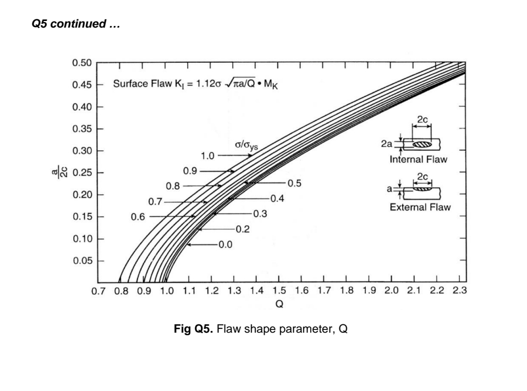
Failure of the pressure vessel can be assumed to occur from embedded elliptical defects orientated perpendicular to the hoop stress. The largest crack found by NDT in the wall of the vessel is an elliptical defect in the welding zone with size of 2a = 8 mm and 2c = 40 mm.
(a) For a factor of safety of 2 based on yielding find the thickness of the thin-walled pressure vessel t.
(b) In this case how much is stress intensity factor and what is the factor of safety against the brittle fracture?
(c) What is the maximum flaw length that can be tolerated before the stress in the casing reach to design stress. Assume the crack aspect ratio a/2c remain unchanged.
(d) Find the plastic zone size for pane strain condition and determine whether the use of LEFM, based on Kic, is likely to be conservative or not for the given dimensions of defects and motor case, i.e. whether plane strain conditions exist.
The stress intensity factor for an embedded crack, at the semi-minor axis position (crack depth a), can be found from 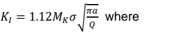

Where a is crack length and t is the vessel thickness. The flow shape parameter Q can be found from Figure Q5 on the next page.
Buy Answer of This Assessment & Raise Your Grades
6. A thin-walled cylindrical autoclave pressure vessel used for manufacturing of fibre reinforced polymer composite materials has an internal radius of 1.5 m and wall thickness of 30 mm. The internal pressure of the autoclave varies from minimum of 0.1 MPa to maximum 4 MPa. The vessel is made from steel with a yield stress of 510 MPa, and Kic = 60 MPa √m. The crack in the vessel wall can be assumed to be semicircular cracks inside the vessel wall, oriented normal to the hoop stress direction. The stress intensity factor for such cracks can be found from:
K1 = Yо√ла where Y = 1.14
The fatigue cracks growth in the pressure vessel wall is governed by Paris law with Paris fatigue constants C = 5.5 x 10⁻¹², and m = 4 when stress intensity factor range is in MPa√m and crack length in m.
(a) Calculate the minimum, maximum and the range of hoop stress under the applied pressure range.
(b) Calculate the critical (final) crack size.
(c) Does the vessel leak-before-break?
(d) By carrying out non-destructive testing of the pressure vessel a crack of 1.8 mm is found. Calculate the number of cycles that the pressure vessel is expected to work before failure?
(e) To ensure the safety of the vessel, the vessel is pressurised under controlled, safe conditions to a test pressure at which the vessel would fail by fracture if a crack of the specified size was present. If the vessel survives the test pressure, one may conclude that no cracks of that size are present. Calculate the test pressure required to ensure no crack longer than a; is present in the vessel wall. Can the vessel sustain this pressure without yielding?
Do You Need Assignment of This Question
SECTION C-
7. (a) Explain how the boundary layer thickness is defined.
(b) Give the definition of the friction coefficient.
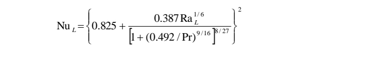
(c) A hot vertical plate at 230°C is placed in a room where the air temperature is 24°C. The plate is 0.80 m high. Air properties at the film temperature are as follows: the thermal conductivity is k = 33.8×10⁻³ W/m K, the kinematic viscosity is v = 26.4×10⁻⁶ m2/s, the thermal diffusivity is a = 38.3×10⁻⁶ m2/s, and the Prandtl number is Pr = 0.69.
Calculate
(i) The film temperature
(ii) The expansion coefficient
(iii) The heat flux from the plate to the air
Note: Nusselt number in free convection flow over a vertical plate is
Are You Looking for Answer of This Assignment or Essay
Facing challenges with your Thermofluids assignment? Our assignment help in UK service provides top-notch Do My Assignment For Me assistance and expert Report Writing Help Services. UK students can pay our specialists for customized support to excel in their studies. Lighten your academic load by getting help from our professional team. Reach out today to achieve academic success with ease!
Answer