
- AP301 Skincare to Support Aesthetic Procedures Assignment Brief 2026
- CO403 Laser Core of Knowledge (J/651/6011) Assignment Brief 2026
- CO402 Client Consultation for Aesthetic Procedures Assignment Brief 2026
- CO401 Health, Safety and Hygiene for Aesthetic Procedures Assignment Brief 2026
- BMG563 Leadership and Change Assessment Brief 2026 | Ulster University
- AP415 Skin Rejuvenation using Dermaplaning (F/650/3429) Assignment Brief 2026
- AP413 Hair Reduction using Laser, Light and Energy-Based Devices Assignment Brief 2026
- AP412 Skin Rejuvenation Using Laser, Light and Energy-Based Devices (A/650/3427) Assignment Brief 2026
- AP414 Skin Rejuvenation using Electrotherapy Assignment Brief 2026
- AP411 Skin Rejuvenation using Mesotherapy Assignment Brief 2026
- AP409 Skin Rejuvenation Using Microneedling Assignment Brief 2026
- AP408 Skin Rejuvenation Using a Plasma Device Assignment Brief 2026
- AP407 Micropigmentation Techniques to Enhance Lips Assignment Brief 2026
- AP406 Micropigmentation Techniques to Enhance Eyes Assignment Brief 2026
- HSC305 Understanding Diabetes Care Assignment Brief 2026
- Qualifi Level 3 HSC304 Person-Centred Care Assignment Brief 2026
- HSC303 Promoting Health in the Population Assignment Brief 2026
- HSC301 An introduction to Health and Social Care Assignment Brief 2026
- IY2T509 Secure Systems Assessment 1, 2026 | University Of South Wales
- AP405 Micropigmentation Techniques to Enhance Eyebrows Assignment Brief 2026
Describe the number of factors, levels and conditions in this design and Explain what is meant by a main effect and an interaction effect: Applied Quantitative Methods Assignment, MMU, UK
| University | Manchester Metropolitan University (MMU) |
| Subject | Applied Quantitative Methods |
Question 3.
A researcher was interested in whether the effectiveness of health messages interacts with the personality of the reader. The study used two types of messages: gain-framed and loss-framed. Gain-framed messages promote the health benefits of exercising, while loss-framed messages emphasize the health risks of not exercising. The researcher was interested in whether the effectiveness of the message frame is different for people with approach-oriented versus avoidance-oriented personalities. People who are approaching-oriented tend to be more motivated by gaining rewards, while people who are avoidance oriented tend to be more motivated by avoiding harm. Participants were tested and classified as either approach-oriented or avoidance oriented. Each participant was randomly allocated to read either gain-framed or loss-framed messages. Their intention to exercise was then measured as the dependent variable.
- Describe the number of factors, levels, and conditions in this design. Explain what is meant by the main effect and an interaction effect by referring to the main and interaction effects that could potentially be obtained in this design.
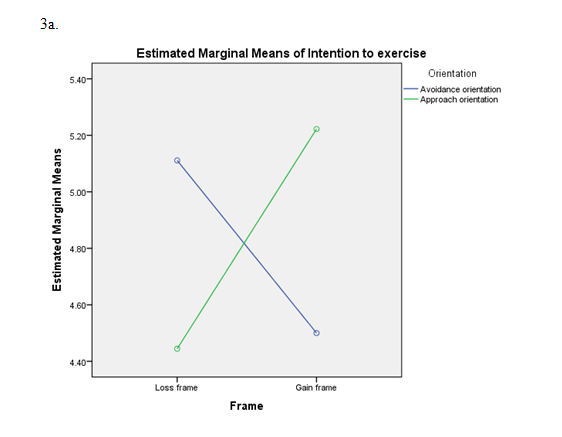
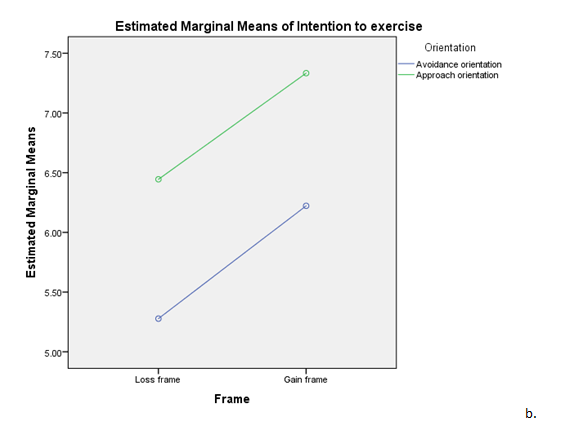
- Graphs 3a & 3b show plots of hypothetical outcomes from this design. What does each graph suggest about the presence or absence of main effects and the presence and type of interaction (if any)? Refer to and describe the features of the graphs to support your answer.
- Briefly identify an appropriate type of statistical analysis to use for this design and explain why it is appropriate.
Buy Answer of This Assessment & Raise Your Grades
Answer