

- AP503 Working Collaboratively with Healthcare Professionals Assignment Brief 2026
- AP502 Professional Standards within Aesthetic Practice Assignment Brief 2026
- AP501 Legal and Regulatory Requirements in Aesthetic Practice Assignment Brief 2026
- 7FNCE015W Global Banking and Lending Assessment 1, 2026 | UOW
- AP301 Skincare to Support Aesthetic Procedures Assignment Brief 2026
- CO403 Laser Core of Knowledge (J/651/6011) Assignment Brief 2026
- CO402 Client Consultation for Aesthetic Procedures Assignment Brief 2026
- CO401 Health, Safety and Hygiene for Aesthetic Procedures Assignment Brief 2026
- BMG563 Leadership and Change Assessment Brief 2026 | Ulster University
- AP415 Skin Rejuvenation using Dermaplaning (F/650/3429) Assignment Brief 2026
- AP413 Hair Reduction using Laser, Light and Energy-Based Devices Assignment Brief 2026
- AP412 Skin Rejuvenation Using Laser, Light and Energy-Based Devices (A/650/3427) Assignment Brief 2026
- AP414 Skin Rejuvenation using Electrotherapy Assignment Brief 2026
- AP411 Skin Rejuvenation using Mesotherapy Assignment Brief 2026
- AP409 Skin Rejuvenation Using Microneedling Assignment Brief 2026
- AP408 Skin Rejuvenation Using a Plasma Device Assignment Brief 2026
- AP407 Micropigmentation Techniques to Enhance Lips Assignment Brief 2026
- AP406 Micropigmentation Techniques to Enhance Eyes Assignment Brief 2026
- HSC305 Understanding Diabetes Care Assignment Brief 2026
- Qualifi Level 3 HSC304 Person-Centred Care Assignment Brief 2026
CE869: Your task for this assignment is to implement a 16 bit CPU To make the assignment feasible within the time frame: High Level Logic Design Assignment, UOE, UK
| University | university of Essex (UOE) |
| Subject | CE869: High Level Logic Design |
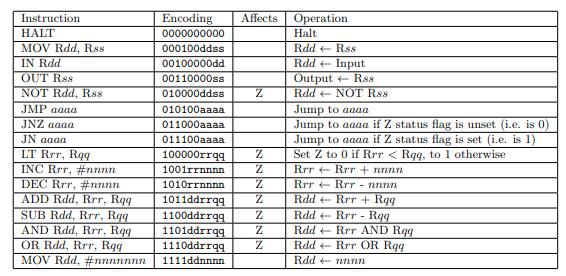
Your task for this assignment is to implement a 16 bit CPU. To make the assignment feasible within the time frame available for this module, the type of CPU will be fairly simple. In particular, the “program sequencing/control flow instruction” datapath can be modeled after the one on the left of Figure 1, while the “arithmetic/logic instruction” datapath can follow a structure like the one on the right in the same figure. Please notice that when RAE and/or RBE is low, the corresponding output(s) will simply match the input “I” to the register file. The opcodes for the instructions that the CPU is required to implement are given in Table 1. You are also required to implement a decode unit in the control unit to interpret the ‘Effects’ and control signals from the output of each instruction.
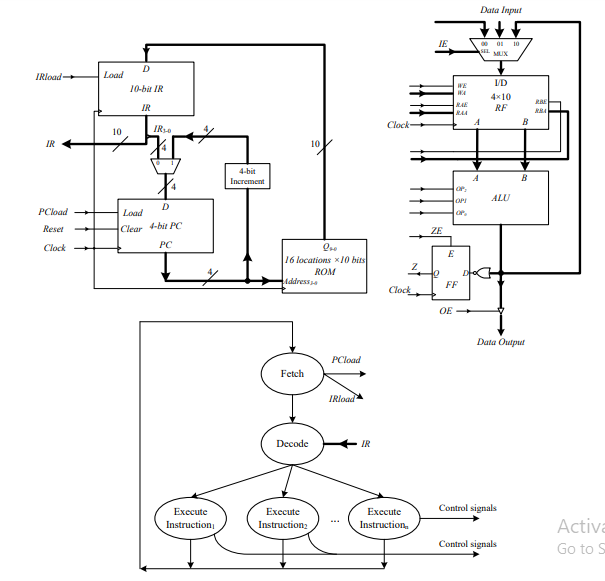
Figure 1: The figure shows the “program sequencing/control flow instruction” datapath and the “arithmetic/logic instruction” datapath (right).
To test your CPU, you will design the main entity that instantiates the CPU and connects it to the Basys3 peripherals. The sixteen switches of the Basys3 board will represent the input to the CPU while its output will be shown as a hexadecimal number in the four digits of the 7-segment display. The central button will be used as a reset signal to the CPU.
To test the CPU you will be asked to code two programs in the assembly and machine languages of the CPU, implementing the following tasks
- Given a nonzero number N as input, output the sum of the natural numbers less than N;
- Given a number N as input, output “N div 11” (i.e. the integer quotient of the division between N and 11, “TRUNC(N/11)”);
These design specifications should be interpreted as guidelines and should not constrain you from improving the CPU by doing modifications that you think would result in a better “product”. The test programs above, though, should be implemented using only the instructions in Table 1. You are welcome to implement more elaborated programs to test the capabilities and the limitations of the CPU.
Do You Need Assignment of This Question
Answer