

- Contemporary Issues in Social Work Practice MA Assignment 2026: Poverty, Neighbourhood Effect and Community Social Work (5,000 Words)
- Entrepreneurship and Innovation MBA Assignment 2026: Business Plan and Reflective Essay on Entrepreneurial Mindsets | ISTEC
- Person-centred Approaches in Health and Social Care Settings Assignment: Guidance Document and Consent Briefing Report | LCPS
- BEM1083DA Business Environment and Organisational Strategy Assessment 2 2026/27: Effective Project Manager Presentation | University of Exeter
- Principles of Business and Resource Management for Leaders of Adult Social Care Assignment Brief 2026 (Level 5 Diploma)
- 7132PY Project Planning and Ethics Capstone Research Ethics Proposal Assignment Brief 2026 | Coventry University
- Property Law Problem Question: Easements, Licences and the Sale of Hardacre (Advise Enya)
- NUR6074 Leadership and Decision Making in Adult Nursing Assessment Brief 2026: Practice Change Presentation | Birmingham City University
- PSY4007 Introduction to Studying Psychology Portfolio Assessment Brief: Five Tasks from Perspectives to Academic Skills | Arden University
- HSO5004 Health Promotion: Challenges and Opportunities Assessment Brief 2026: Health Promotion Event and Evaluation Report | Regent College London
- CIPD Level 3 3CO01 Business, Culture and Change in Context Assessment Questions: Gearspan Ltd Case
- DL503 Land Law Assignment Brief 2026: Qualifi Level 5 Diploma in Law (Proprietary Estoppel and Case Study)
- CIPD 5LD01 Support Informal and Self-Directed Learning Assessment Brief 2026: Lux-stay Case Study
- SPY00157M Exploring Policy Research Summative Assessment Brief 2026 | University of York
- COM4024 Introduction to Academic Skills and Professional Development Assessment Brief 2026 | Arden University
- VTCT Level 4 UBT501 and UBT503 SAR Assignment Paper B Brief 2026
- CET3016 Enterprise Software Engineering Assignment 1 2026: SunMortgages Analysis and Design | Sunderland
- Unit 8204 Working in Partnership with Others and Unit 8201 Person-Centred Assessment Questions: Level 4 Diploma in Adult Care
- AP503 Working Collaboratively with Healthcare Professionals Assignment Brief 2026
- AP502 Professional Standards within Aesthetic Practice Assignment Brief 2026
Select and apply appropriate computational and analytical techniques to model complex problems, recognising the limitations of the techniques employed :AHEP- Assignment 1 , UK
| Subject | AHEP Assignment |
Overview
In this coursework you will work through a series of exercises that will lead to the design of a power supply and you will demonstrate them through MATLAB simulations. Throughout the completion of these design and analysis exercises, you will develop skills in dealing with complex problems and providing effective solutions for such problems.
All information required for completion has been provided or covered in module laboratory sessions. You will be expected to perform independent research and further study as appropriate to aid completion. You should write a report based on the requirements of the attached brief and this should be an individual submission. This assessment counts for 50% of the total module marks.
Do You Need Assignment of This Question
Module Learning Outcomes
This ICA will assess the following Learning Outcomes as documented in the module specification and handbook:
Personal and Transferrable Skills
- Identify and use appropriate analytical methods to evaluate industrial electronic systems.
- Communicate effectively, using technical report writing skills and selection of appropriate information presentation methods.
Research, Knowledge, and Cognitive Skills
- Produce a specification for an industrial electronic system or industrial electronic product.
- Describe and explain the operation of simple industrial electronic systems.
- Demonstrate an understanding of the operating principles of individual components that form an integrated system.
Professional Skills
- Examine industrial electronic systems in a practical environment and describe their role within general engineering applications.
AHEP 4 Learning Outcomes
This module assesses the following AHEP4 (Accreditation of Higher Education Programmes) learning outcomes at ISCED (International Standard Classification of Education) level 6.
Research, Knowledge, and Cognitive Skills
- Select and apply appropriate computational and analytical techniques to model complex problems, recognising the limitations of the techniques employed (C3).
Personal and Transferrable Skills Development
- Evaluate the environmental and societal impact of solutions to complex problems and minimise adverse impacts (C7).
- Use practical laboratory and workshop skills to investigate complex problems (C12).
- Select and apply appropriate materials, equipment, engineering technologies and processes, recognising their limitations (C13).
Professional Skills, Values and Behaviours
- Function effectively as an individual, and as a member or leader of a team (C16).
Buy Answer of This Assessment & Raise Your Grades
Assessment Brief
Introduction
Switching to Electric Vehicles (EV) can effectively contribute to sustainable mobility by making vehicles more energy efficient and reducing greenhouse gas emissions. This shift to electric power can lead to a cleaner environment overall. This assessment focusses on the design and simulation of a power supply system for a 50 kW Electric Vehicle Fast Charging System, incorporating various components and loads as shown in Figure 1.
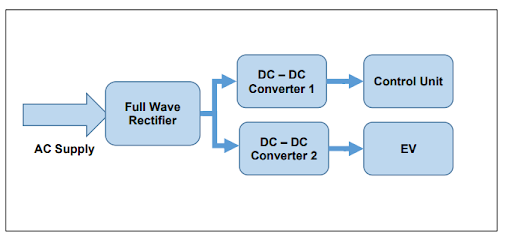
Figure 1 – Overall System Diagram
The AC supply to the full wave rectifier is 230 V single phase AC at 50Hz.
The loads are as follows:
- The output of DC-DC Converter 1 is to be 30 V to power the control system.
- The output of DC-DC Converter 2 is to be 500 V to charge the batteries of an electric vehicle directly
Activity 1: AC-DC conversion system design (20 %)
You are required to design and simulate an AC-DC conversion system for a 50 kW EV Fast Charging System. The system is powered by a 230 V single phase AC supply at 50 Hz.
Rectifier Design Design and simulate a full wave rectifier for this system. You may assume that:
- The load resistance, R, is 3 Ω.
- The load inductance, L, is 50 mH.
- The source resistance, RS, is 2 mΩ. •
The source inductance, LS, is 60 µH. Your design report should include the following:
1. Identification of key parameters for the selection of the diodes to be used and specifications for their values.
2. A simulation to validate the operation of the circuit, presented with appropriate graphs.
3. Explanation of your choice of filter components you would use to design a filter to smooth the rectified output.
4. A summary of the performance of this rectifier to include the form factor and efficiency, including comments on these values and their significance.
Activity 2: DC-DC Converter 1 Design (25%)
Design a DC-DC converter to provide a stable 30 V to power the control system with minimal voltage ripple. Since this circuit will supply the control system you should ensure the output voltage ripple does not exceed 5% of the output voltage.
Your design work should include:
1. Calculation of the DC input voltage based on the output of the rectifier.
2. Selection of appropriate values of the inductor L and Capacitor C.
3. Determination of a suitable switching frequency.
4. Justifications with design calculations and appropriate explanation.
5. Simulation of the circuit and presentation of the results to demonstrate its performance.
6. Description of any significant consideration for the selection of the components.
Activity 3: DC-DC Converter 2 Design (25%)
Design a DC-DC converter to provide a stable 500 V output for charging the batteries of an EV. The output voltage ripple must not exceed 10% of the output voltage.
Your design work should include:
1. Identification of the type of converter required.
2. Calculation of appropriate component values.
3. Determination of a suitable switching frequency.
4. Justifications with design calculations and appropriate explanation.
5. Simulation of the circuit and presentation of the results to demonstrate its performance.
6. Description of any significant considerations for the selection of the components.
Activity 4: Simulation of Entire System (20%)
Integrate the individual models you have created above and simulate the performance of the integrated system. The nature of EV charging is that the amount of current delivered to the battery is regulated by the EV’s onboard system. You should therefore investigate the behaviour of the charging system at a range of power settings, ranging from 10 kW to 50 kW.
You should provide results and commentary related to:
1. Evaluation of the overall efficiency of the system across the specified range of outputs.
2. Analysis of the harmonic content of the input current drawn from the supply.
3. Calculation of the power factor of the system.
4. Evaluation of the system based on the above and any other relevant factors you wish to consider, to include any recommendations for how the system could be improved.
Activity 5: Application of Embedded Systems in Industrial Electronics (10%)
Based on your design and simulation on the demonstration of the power electronic converters, answer the following questions:
1. Provide a general definition for embedded systems. Using an appropriate schematic, identify the core components of an embedded system linked to each other.
2. List and explain common types of embedded systems that are categorised based on their functional requirements.
3. Explain how an embedded system facilitates the implementation of the control unit of a power converter.
Are You Looking for Answer of This Assignment or Essay
Need help with your AHEP (Accreditation of Higher Education Programmes) – Assignment 1? Our assignment writing help UK service is ready to assist! UK students can pay someone to do my assignment for me and benefit from our exceptional report writing services. We deliver affordable, high-quality services, with 100% human-written assignments—no AI—guaranteeing A+ results, on-time delivery, and plagiarism-free content. Trust our experts to help you excel in your assignments and achieve your academic goals!
Shared with

Answer