

- DAI504 Human-AI Interaction (Y/651/0608) Assignment Brief 2026
- DAI503 Natural Language Processing (T/651/0607) Assignment Brief 2026
- Qualifi Level 5 DAI501 Visualisation (M/651/0605) Assignment Brief 2026
- DAI406 Artificial Intelligence Ethics (L/651/0604) Assignment Brief 2026
- DAI404 Big Data Management (J/651/0602) Assignment Brief 2026
- DAI402 Mathematical Foundations for Machine Learning (F/651/0600) Assignment Brief 2026
- DAM101 Programming and Algorithms Final Assessment 2026 | City St George’s
- HRM09105 Leadership in Organisations Assessment Brief 2026 | ENU
- Research Methods for Business and Psychology Assessment Brief 2026
- SWE4201 Introduction to Software Development Assignment Brief 2026
- 7CO03 Personal Effectiveness, Ethics and Business Acumen Assignment Brief 2026
- MLA725 Developing Sustainable Energy Assessment Brief 2026 | MLA College
- BMA4002 Economics and Globalisation Assignment 1 Brief 2026 | BSU
- CMI Unit 716 Strategic Approaches to Mental Health and Wellbeing (Y/617/6873) Assignment Brief 2026
- CMI Unit 714 Personal and Professional Development for Strategic Leaders (Y/617/6873) Assignment Brief 2026
- CMI Unit 712 Strategic Management Project (A/617/6871) Assignment Brief 2026
- CMI Unit 710 Marketing Strategy (J/617/6870) Assignment Brief 2026
- CMI Unit 708 Strategic Risk Management (L/617/6868) Assignment Brief 2026
- CMI Unit 706 Finance for Strategic Leaders (F/617/6866) Assignment Brief 2026
- MKT09401 International Marketing Assignment Brief 2026 | ENU
BTEC Unit 19 Electrical and Electronic Principles : Analysis of Circuits with Constant Voltages and Currents HNC Level 4 , Assignment 1, UK
| Subject | Analysis of Circuits with Constant Voltages and Currents |
Learning Outcomes and Assessment Criteria:
LO1 Apply an understanding of fundamental electrical quantities to analyse circuits with constant voltages and currents
P1 Apply the principles of circuit theory to simple circuits with constant sources, to explain the operation of that circuit.
M1 Apply the principles of circuit theory to a range of circuits with constant sources, to explain the operation of that circuit.
D1 Examine the operation of a range of circuits with constant sources, including power analysis, using relevant circuit theories.
Do You Need Assignment of This Question
Unit Learning Outcomes:
Apply an understanding of fundamental electrical quantities to analyse circuits with constant voltages and currents
Assignment Brief and Guidance:
Scenario
You have completed your engineering apprenticeship and have a position in the design department of a electronics consultancy company that offers a range of services. You have been asked by your line manager to reduce the layout of various circuits so that they fit to size of the PCB as specified by the customer. The customer has also asked if current and power can be calculated so they can specify the values in the product technical documents.
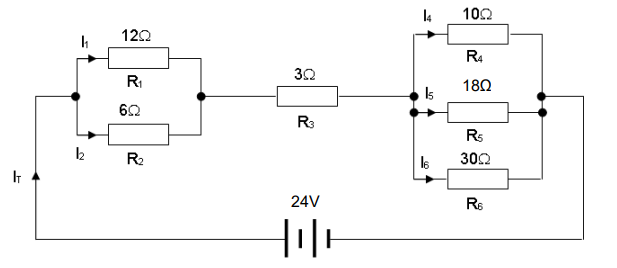
Apply the principles of circuit theory for the circuit shown and determine:
(i) the total resistance (RT).
(ii) the total current (IT) supplied by the battery.
(iii) the current flowing through each resistor.
(iv) the total power consumed by the circuit.
(v) Explain and examine the operation of the circuit.
Do You Need Assignment of This Question
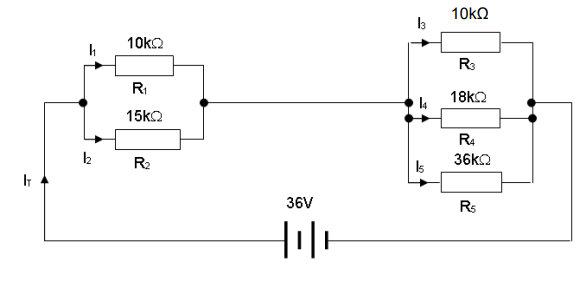
Apply the principles of circuit theory for the circuit shown and determine:
(i) the total resistance (RT).
(ii) the total current (IT) supplied by the battery.
(iii) the current flowing through each resistor.
(iv) the total power consumed by the circuit.
(v) Explain and examine the operation of the circuit.
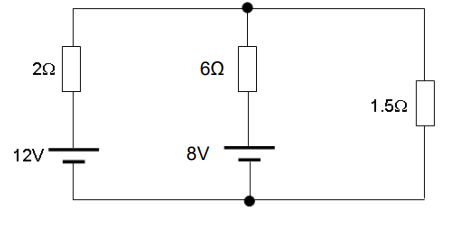
Two batteries A and B are connected in parallel, and a 1.5Ω resistor is connected across the battery terminals. The e.m.f. of and internal resistance of battery A are 12V and 2Ω respectively, and the corresponding values for battery B are 8V and 6Ω respectively. Apply Kirchhoff’s Laws to determine:
(i) the value and direction of the current in each battery.
(ii) the current flowing in and the p.d. across the 1.5Ω resistor.
(iii) Explain and examine the operation of the circuit.
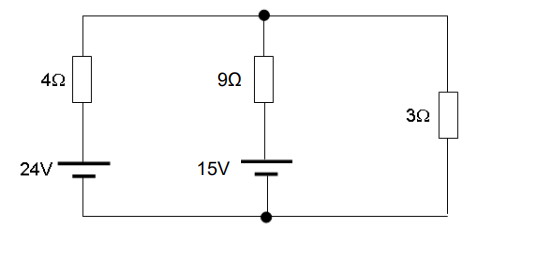
Two batteries A and B are connected in parallel and a load of 3Ω is connected across their terminals. Battery A has an e.m.f. 24V and internal resistance of 4Ω; battery B has an e.m.f of 15V and an internal resistance 9Ω. Apply Kirchhoff’s Laws to determine:
(i) the values and directions of the currents in each branch of the circuit. (
ii) the p.d. across the external resistor i.e. the 3Ω resistor.
(iii) Explain and examine the operation of the circuit.
Buy Answer of This Assessment & Raise Your Grades
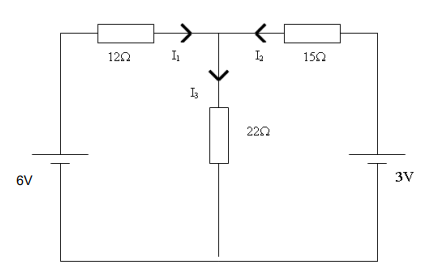
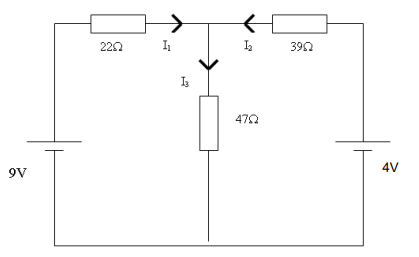
Apply Superpostion theory to the circuits below to determine the branch currents I1, I2 and I3 and explain and examine the operation of the circuits.
Are You Looking for Answer of This Assignment or Essay
Looking for UK assignment help with your Analysis of Circuits with Constant Voltages and Currents, Assignment 1? We offer expert BTEC assignment assistance for students, including Unit 19 Electrical and Electronic Principles Assignment examples. Get affordable, high-quality services with 100% human-written assignments—no AI involved! We promise A+ results, guaranteed on-time delivery, and plagiarism-free content. UK students can pay our experts to get the help they need to ace their courses!
Answer