
- MLA603 Maritime Regulation & Governance Assignment Information 2026 | MLA College
- ILM Unit 507 Understanding the Organisational Environment Assessment 2026
- Advanced Management Accounting Assessment Information 2026 | University of Salford
- GEOG20091 Sustainability Formative Assessment Brief 2026 | Nottingham Trent University
- 6BM500 Business Psychology Assessment Brief 2026 | University of Derby
- MS1S463 Problem Solving for Computing Assessment Brief 2026 | USW
- HWSC5005 Applied Research in Practice Assignment Brief 2026 | OBU
- Qualifi Level 7 Unit 724 Development as a Strategic Manager Assignment Brief 2026
- A6001C17 Advances in Animal Production Science Assignment Brief 2026 | HAU
- SOCI5270 Contemporary Sociological Theory Essay Assessment 2026 | UOK
- 4BE002 The Innovative Business Assignment Brief 2026 | University of Wolverhampton
- CIPD Level 5 5LD01 Support Informal and Self-Directed Learning Assessment Brief 2026
- COM4016 Productivity and Collaboration Tools for Learning and Work Assessment Brief 2026 | Arden University
- CA6060 Financial Decision-Making in Context for Aviation Assignment 2 Question 2026
- NCFE CACHE Level 3 Diploma for Working in the Early Years Sector Assessment Brief 2026
- CRN 63466 / CRN 63467 Statutory Valuation Level 7 Assessment Brief 2026 | USM
- BSM24105 Operations and Project Management Assessment Brief 2026 | RUL
- Professional Communication Assessment 1 Semester 2, 2026 | UGM
- LAW7128 Conflict Resolution in Business Assignment Brief 2026 | BCU
- MLA604 Maritime Operations Assessment Brief Jan 2026 | MLA College
NI523 Approaches to Nursing Adults with Long Term Conditions Assignment Workbook 2026 | UOB
| University | University of Brighton (UOB) |
| Subject | NI523 Approaches to Nursing Adults with Long Term Conditions |
NI523 Assignment Workbook
A Student’s Guide to the Reflective Case Study
Introduction
Welcome to your NI523 Assignment Workbook. This guide is designed to be your companion throughout the assignment process. Its purpose is to help you break down the task into manageable steps, prepare for each support workshop, and build the foundations for a successful final submission.
You will get the most benefit from this process if you work through and update this workbook throughout the module and each of the dedicated assignment workshops. By actively engaging with the activities inside, you will develop your ideas, refine your writing, and gain a clear understanding of what is required to excel in this reflective analysis.
This workbook is, however, totally optional – it is for you to decide how this will best support you in your assignment development. It is written with the intention of you being able to start at the beginning and work through systematically (in line with the in-person teaching events) OR to dip in to whichever sections YOU feel would be most beneficial to you.
Contents
- Part 1: The Assignment Journey – Introduction & Workshop Planner
- Part 2: Deconstructing the Assignment & Forming Initial Ideas – Deconstructing the task and forming your initial ideas.
- Part 3: The Marking Criteria – Understanding what we’re looking for and how to achieve higher grades.
- Part 4: Preparing for the Formative Peer Assessment – Preparing for and learning from feedback.
- Part 5: Deepening your Analysis – Post-Workshop Activities – Further building on your formative ideas with reflections from subsequent workshops
- Appendix: Pre-Submission Checklist
Part 1: The Assignment Journey – Introduction & Workshop Planner
This module includes a series of workshops designed to support you at each stage of the assignment. Use this planner to track your progress.
| Workshop | Focus | My Key Takeaway / Action Point |
| Workshop 1: The Good, the Bad, and the Ugly | Decoding the marking criteria and understanding the difference between a fail, pass, and merit. | |
| Workshop 2: Mental Health Case Study | Practising the identification and prioritisation of complex psycho-social care needs. | |
| Workshop 3: The Formative Prep Zone | Building your essay plan and drafting your 250-word sample for peer review. | |
| Workshop 4: Using Generative AI Effectively | Learning how to use AI tools ethically to find evidence and strengthen critical thinking. | |
| Workshop 5: Health Behaviour Change | Exploring person-centred and sustainable care planning with a service user consultant. | |
| Workshop 6: Analysing ‘Social Murder’ | Developing critical thinking skills by analysing structural influences on health. |
Part 2: Deconstructing the Assignment & Forming Initial Ideas
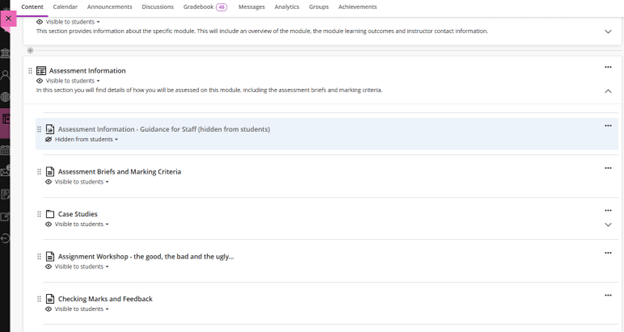
Resources for this section are on My Studies in the Assessment Information section. There are resources in the subsection entitled Assessment Briefs and Marking Criteria and also the section for the first workshop, where the assignment is introduced, entitled Assignment Workshop – the good, the bad and the ugly:
Activity 2.1: Deconstructing the Core Task
The assignment title contains all the key instructions you need. In the boxes below, write down what each key phrase means to you in your own words.
“The student will write a reflection on their nursing decision making in the assessment and planning of the complex care needs of an adult to live well with a long-term health condition and include analysis of the evidence base of two care needs.”
My understanding of…
| Key Phrase | My Notes |
| Reflection on nursing decision making | |
| Assessment and planning | |
| ‘Living well’ with a long-term condition | |
| Analysis of the evidence base of two care needs |
|
Activity 2.2: Initial Case Study Brainstorm
You have three options for your case study. Use this space to think about which you might choose and why.
Which option are you leaning towards? (Circle one)
- A patient from my clinical practice
- A provided paper-based case study (e.g., Seb)
- A family member or person I know
Initial Ideas & Rationale:
(Who are you thinking of? What are their long-term conditions? What care needs might you prioritise? Why would they be a good subject for this assignment?)
Confidentiality Pledge: I understand that I must anonymise all details of my chosen individual and include a confidentiality statement in my assignment, as per the NMC Code (2018).
Signature: _________________________
Activity 2.3: Identifying & Prioritising Care Needs (The Funnel Approach)
Let’s use the Seb case study as an example. From the summary, list as many potential care needs as you can in the top of the funnel.
All Potential Care Needs for Seb:
| (e.g., Medication adherence, housing instability, mental health support, social isolation, risk of STIs, self-stigma…) |
Now that you have listed a broad range of care needs for Seb, select just two that you think are the highest priority and justify your choice below.
| Seb’s Priority Care Needs & Rationale: | Describe the Care Need | Provide a Rationale |
| 1. Priority Need 1: | ||
| 2. Priority Need 2: |
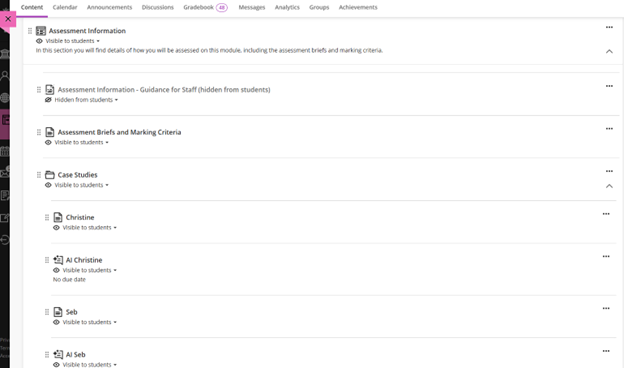
NB: if you’re now sure and want a bit of help with this, why not discuss it with the AI Seb on the module site. He’s in the Assessment Information section within the Case Studies folder:
Activity 2.3: Workshop 2: Learning from the Mental Health Case Study
In this workshop, we worked through a complex mental health case study. Reflect on that process to help with your own assignment.
| What were the key challenges in identifying the underlying psycho-social needs in the case study, beyond the obvious physical ones? |
| How did the group decide which two needs to prioritise? What factors did we consider (e.g., risk, patient preference, potential for impact)? |
| My key learning from this workshop that I will apply to my own case study is: |
Need Help with NI523 Reflective Case Study?
Part 3: The Marking Criteria
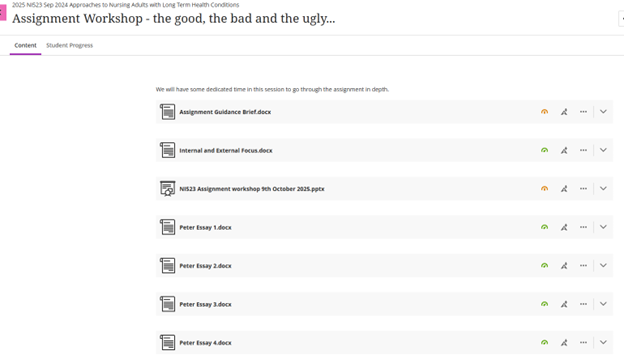
Resources for this section are on My Studies in the Assessment Information section. There are resources in the subsection entitled Assessment Briefs and Marking Criteria and also the section for the first workshop, where the assignment is introduced, entitled Assignment Workshop – the good, the bad and the ugly. This is where you will find the sample essays Peter Essays 1 to 4.
Activity 3.1: Decoding the Grade Descriptors
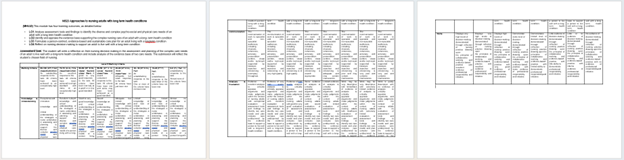
The marking rubric uses specific terms to distinguish between different grades. What do you think is the practical difference between them?
| Grade & Key Phrase | What I think this looks like in writing… |
| Pass (40-59%): “Sound knowledge,” “Some evidence of analysis.” | |
| Merit (60-69%): “Good to very good…critical understanding,” “High-quality analysis.” | |
| Distinction (70%+): “Exceptional and innovative knowledge,” “Excellent and exceptional analysis.” |
Activity 3.2: Marking Sample Paragraphs
In the Workshop, we looked at sample paragraphs across the four sample essays relating to one of the Marking Criteria. The sample essays are designed to reflect grade levels as follows:
- Peter Essay 1 – a “Just failed” assignment with scores in the 30-39% range in all 4 marking criteria
- Peter Essay 2 – a “Just passed” assignment with scores in the 40-49% range in all 4 marking criteria
- Peter Essay 3 – a “Merit” assignment with scores in the 60-69% range in all 4 marking criteria
- Peter Essay 4 – a “First Class/Distinction” assignment with scores over 70% in all 4 marking criteria
Activity 3.2.1 Marking Sample Paragraphs against the Knowledge and Understanding Marking Criteria
The table below shows the marking criteria at the different levels for each of the sample essays. Note the highlighted sections – these show what markers are looking for to differentiate between grade bandings:
| Marking Criteria | Peter Essay 4 | Peter Essay 3 | Peter Essay 2 | Peter Essay 1 |
| 70-79 (A A-) Firs class/Distinction An excellent response to the task. All criteria have been achieved to a high standard and many at an exceptionally high level | 60-69 (B+ B B-) Upper Second class/ Merit: A good to very good response to the task. All criteria have been met fully at a good or a very good standard | 40-49 (D+ D D-) Third class/Pass: An adequate, but weak response to the task All criteria have just been met | 30- 39 (E+ E E-) Fail: An unsatisfactory response to the task One or more of the criteria have not been met | |
| Knowledge & Understanding | Excellent in-depth knowledge and critical understanding of the strategies a nurse undertakes in assessing and planning to support the diverse and complex psycho social and physical care needs of a person living with a long-term health condition. | Good to very good knowledge and critical understanding of the strategies a nurse undertakes in assessing and planning to support the diverse and complex psycho social and physical care needs of a person living with a long-term health condition. | Adequate but limited knowledge with little critical understanding of the strategies a nurse undertakes in assessing and planning to support the diverse and complex psycho social and physical care needs of a person living with a long-term health condition.
| Limited knowledge of and lack of critical understanding of the strategies a nurse undertakes in assessing and planning to support the diverse and complex psycho social and physical care needs of a person living with a long-term health condition. |
Looking across the four sample essays will show you a progression through different grade bandings. For this marking criteria, suggested sections are:
- A: The introduction paragraph.
- B: The discussion of “social isolation” (Section C).
- C: The description of care planning/interventions (Sections B & C).
Select one of these and look at the same section across all four essays.
Use the grid below to note your reflections based on the Knowledge and Understanding criterion.
Sample Section Chosen: _________________________
| Prompt | My Reflections |
| What did you notice about the differences in the Grades awarded (through Fail / Pass / Merit / Distinction): | |
| What, therefore, do you think you need to make sure you do in your assignment: | |
| What, therefore, do you think you need to make sure you avoid doing in your assignment: |
|
| How might this influence your choice of Case Study: |
|
Activity 3.2.2 Marking Sample Paragraphs against the Analysis and Evaluation Marking Criteria
The table below shows the marking criteria at the different levels for each of the sample essays. Note the highlighted sections – these show what markers are looking for to differentiate between grade bandings:
| Marking Criteria | Peter Essay 4 | Peter Essay 3 | Peter Essay 2 | Peter Essay 1 |
| 70-79 (A A-) Firs class/Distinction An excellent response to the task. All criteria have been achieved to a high standard and many at an exceptionally high level | 60-69 (B+ B B-) Upper Second class/ Merit: A good to very good response to the task. All criteria have been met fully at a good or a very good standard | 40-49 (D+ D D-) Third class/Pass: An adequate, but weak response to the task All criteria have just been met | 30- 39 (E+ E E-) Fail: An unsatisfactory response to the task One or more of the criteria have not been met | |
| Analysis and Evaluation | Evidence of very high quality analysis to critically appraise arguments and make judgments within the context of nursing adults with excellent evaluation of assessment tools and findings to identify two care needs and plan complex care underpinned by the evidence base to support a person to live well with a long-term health condition.. | Evidence of high quality analysis to critically appraise arguments and make judgments within the context of nursing adults with good to very good evaluation of assessment tools and findings to identify two care needs and plan complex care underpinned by the evidence base to support a person to live well with a long-term health condition. | Limited evidence of analysis to critically appraise arguments and make judgments within the context of nursing adults with limited evaluation of assessment tools and findings to identify two care needs and plan complex care underpinned by the evidence base to support a person to live well with a long-term health condition. | Work may be very descriptive with limited/lack of evidence of analysis to critically appraise arguments and make judgments within the context of nursing adults with insufficient evaluation of assessment tools and findings to identify two care needs and plan complex care underpinned by the evidence base to support a person to live well with a long-term health condition. |
Looking across the four sample essays will show you a progression through different grade bandings. For this marking criteria, suggested sections are:
- A: The justification for prioritising the two care needs (Section A).
- B: The evaluation of the food/glucose diary (Section B).
- C: The analysis of the social prescribing intervention (Section C).
Select one of these and look at the same section across all four essays.
Use the grid below to note your reflections based on the Analysis and Evaluation criterion.
Sample Section Chosen: _________________________
| Prompt | My Reflections |
| What did you notice about the differences in the Grades awarded (through Fail / Pass / Merit / Distinction): | |
| What, therefore, do you think you need to make sure you do in your assignment: | |
| What, therefore, do you think you need to make sure you avoid doing in your assignment: |
|
| How might this influence your choice of Case Study and/or Care Needs: |
|
Activity 3.2.3 Marking Sample Paragraphs against the Skills Marking Criteria
The table below shows the marking criteria at the different levels for each of the sample essays. Note the highlighted sections – these show what markers are looking for to differentiate between grade bandings:
| Marking Criteria | Peter Essay 4 | Peter Essay 3 | Peter Essay 2 | Peter Essay 1 |
| 70-79 (A A-) Firs class/Distinction An excellent response to the task. All criteria have been achieved to a high standard and many at an exceptionally high level | 60-69 (B+ B B-) Upper Second class/ Merit: A good to very good response to the task. All criteria have been met fully at a good or a very good standard | 40-49 (D+ D D-) Third class/Pass: An adequate, but weak response to the task All criteria have just been met | 30- 39 (E+ E E-) Fail: An unsatisfactory response to the task One or more of the criteria have not been met | |
| Skills | Displays very high levels of decision-making demonstrated through reflection of nursing practice drawing upon the principles of collaborative working and evidence-based practice with excellent evidence of professional responsibility and initiative. | Displays high levels of decision-making demonstrated through reflection of nursing practice drawing upon the principles of collaborative working and evidence-based practice with very good evidence of professional responsibility and initiative. | Demonstrates limited level of decision-making demonstrated through reflection of nursing practice drawing upon the principles of collaborative working and evidence-based practice with limited ability to demonstrate professional responsibility and initiative. | Little evidence of decision-making demonstrated through reflection of nursing practice drawing upon the principles of collaborative working and evidence-based practice with little ability to demonstrate professional responsibility and initiative.
|
Looking across the four sample essays will show you a progression through different grade bandings. For this marking criteria, suggested section is Section D: The Reflection.
Look at this same section across all four essays and in particular:
- Track how the reflection progresses from a superficial diary entry to a profound analysis of professional growth.
- How did the analysis within the reflection deepen?
- What was the difference in the ‘learning’ that took place?
- How did the action plan evolve?
- Note the progression from a simple to-do list (“I will use models”) to a statement of professional commitment rooted in a new philosophy of care (“commitment to a salutogenic model”).
Use the grid below to note your reflections based on the Analysis and Evaluation criterion.
Sample Section Chosen: _________________________
| Prompt | My Reflections |
| What did you notice about the differences in the Grades awarded (through Fail / Pass / Merit / Distinction): | |
| What, therefore, do you think you need to make sure you do in your assignment: | |
| What, therefore, do you think you need to make sure you avoid doing in your assignment: | |
| How might this influence your choice of Case Study and/or Care Needs: |
Activity 3.2.4 Marking Sample Paragraphs against the Communication Marking Criteria
The table below shows the marking criteria at the different levels for each of the sample essays. Note the highlighted sections – these show what markers are looking for to differentiate between grade bandings:
| Marking Criteria | Peter Essay 4 | Peter Essay 3 | Peter Essay 2 | Peter Essay 1 |
| 70-79 (A A-) Firs class/Distinction An excellent response to the task. All criteria have been achieved to a high standard and many at an exceptionally high level | 60-69 (B+ B B-) Upper Second class/ Merit: A good to very good response to the task. All criteria have been met fully at a good or a very good standard | 40-49 (D+ D D-) Third class/Pass: An adequate, but weak response to the task All criteria have just been met | 30- 39 (E+ E E-) Fail: An unsatisfactory response to the task One or more of the criteria have not been met | |
| Communicatoin | The commuincation of work to specialist and non-specialist audiences, including structure, coherence, accuracy and presentation (written, visual and/or technical) supported by literature searches and referencing is of very high quality. | The commuincation of work to specialist and non-specialist audiences, including structure, coherence, accuracy and presentation (written, visual and/or technical) supported by literature searches and referencing is of high quality. | The commuincation of work to specialist and non-specialist audiences, including structure, coherence, accuracy and presentation (written, visual and/or technical) supported by literature searches and referencing is adequate and may contain inaccuracies. | The commuincation of work to specialist and non-specialist audiences, including structure, coherence, accuracy and presentation (written, visual and/or technical) supported by literature searches and referencing is poor and may contain inaccuracies.
|
Now that you’ve been looking across the four sample essays at the other three marking criteria
- Structure and flow of the narrative – does it make sense for you as a reader?
- Clarity – are you clear as a reader on what the author is saying?
- Academic voice – does the author build powerful and persuasive arguments? Is so how do they do this?
- References – do these look like they are accurately following the Harvard system? Are references used to weave into the narrative to support the coherence of the argument?
Use the grid below to note your reflections based on the Communication criterion.
Sample Section Chosen: _________________________
| Prompt | My Reflections |
| What did you notice about the differences in the Grades awarded (through Fail / Pass / Merit / Distinction): | |
| What, therefore, do you think you need to make sure you do in your assignment: | |
| What, therefore, do you think you need to make sure you avoid doing in your assignment: | |
| How might this influence your choice of Case Study and/or Care Needs: |
Part 4: The Formative Peer Feedback Workshop
This section is designed to help you prepare FOR and get the most FROM the peer feedback session. The deadline for the formative submission is 31st October 2025.
The Formative Process – An Overview
This year, the formative is a voluntary, anonymous peer-review activity designed to help you develop your skills in giving and receiving constructive feedback.
PREPARE: Use Workshop 3 to build your essay plan and draft your writing sample.
SUBMIT: Submit your plan and sample to the designated link on My Studies by the deadline.
REVIEW: After the deadline, you will be anonymously allocated a peer’s submission to review.
FEEDBACK: You will use a simple marking guide to provide anonymous, constructive feedback. You will then receive feedback on your own work.
Activity 4.1: Preparing My Formative Submission (Max 500 words)
Use this template to draft the two required components for your formative submission.
Part 1: Bullet Point Essay Plan (Max 150 words)
| Briefly give an outline of your chosen case study person – what are the key elements of their psychosocial context and what long term condition(s) do they have? |
| Chosen Care Need 1 & Rationale: |
| Chosen Care Need 2 & Rationale: |
| Outline any assessment tools you plan to use and how you will evaluate their evidence base: |
| Outline any interventions you plan to use and how you will evaluate their evidence base: |
| Outline what reflective model do you plan to use and why: |
Part 2: Sample of Writing (250 words)
Draft a paragraph from your main assignment here (e.g., your analysis of Care Need 1). Remember to include at least two references, correctly formatted in Cite Them Right Harvard style.
Activity 4.2: A Framework for Constructive Peer Feedback
When reviewing your peer’s work in the workshop, use this “3-2-1” method to provide structured, helpful feedback.
Feedback:
| 3 Things I liked about your work: | 1 |
| 2 | |
| 3 | |
| 2 Questions I have for you: | 1 |
| 2 | |
| 1 Suggestion for improvement: | 1
|
Activity 4.3: My Feedback Action Plan
After receiving feedback from your peers and tutors, use this space to reflect and create a clear action plan.
| Feedback I Received: (Summarise the key points of feedback you were given) | |
| My Action Plan: (List 3-5 specific, actionable steps you will take to improve your final assignment based on this feedback.) | 1
|
| 2 | |
| 3 | |
| 4 | |
| 5 |
Part 5: Deepening Your Analysis – Post-Workshop Activities
Workshop 4 Activity: Using Generative AI
In this workshop, we explored how to use AI ethically and effectively. Now, apply it to your assignment.
- Take one of your chosen care needs (e.g., “managing medication adherence in a patient with low health literacy”).
- Use a generative AI tool with the following prompt: “Act as a nursing academic. Find me three recent, peer-reviewed academic papers that discuss the challenges and evidence-based interventions for [insert your care need here]. For each paper, provide a one-sentence summary of its key argument.”
- Now, find those papers on the university library database. Does the AI summary match the abstract? Use this as a starting point for your evidence search.
AI-Generated Evidence & My Evaluation:
| AI-Generated Evidence | My Evaluation: |
| Paper 1: | |
| Paper 2: | |
| Paper 3: |
Now, let’s apply this to support your critical thinking in your assignment.
- Take one of you’re the elements you intend to critically evaluate within your assignment – this could be your choice of nursing model (such as the Roper Logan and Tierney model), and assessment/evaluation tool (such as the MUST) or an intervention (such as CBT for depression).
- Use a generative AI tool to explore the strengths, the limitations and the alternatives for this chosen element. For example:
- “Act as a nursing academic. Find me three academic papers that discuss the strengths or evidence for [insert your element here such, such as “the RLT model”]. For each paper, provide a one-sentence summary of its key argument.”
- “Act as a nursing academic. Find me three academic papers that critique the limitations and challenges for [insert your element here such, such as “the RLT model”].For each paper, provide a one-sentence summary of its key argument.”
- “Act as a nursing academic. Find me three academic papers that compare [insert your element here such, such as “the RLT model”] against a suitable alternative.For each paper, provide a one-sentence summary of its key argument.”
- Now, find those papers on the university library database. Does the AI summary match the abstract? Use this as a starting point for your evidence search.
AI-Generated Evidence & My Evaluation:
| AI-Generated Evidence | My Evaluation: |
| Paper 1: | |
| Paper 2: | |
| Paper 3: |
Now formulate this into a short few sentences that show you have considered the strengths, limitations, alternatives and applicability to your patient:
Workshop 5 Activity: Health Behaviour Change
In this workshop, we discussed sustainable, person-centred care planning with a service user consultant.
Reflecting on the service user’s perspective, what is the difference between a care plan that is done to a patient versus one that is created with them?
For one of your care needs, brainstorm three ‘SMART’ goals. Now, rewrite them to be more collaborative and focused on what the patient wants to achieve.
| My Initial ‘SMART’ Goal | My New ‘Collaborative’ Goal |
| e.g., Patient will reduce HbA1c by 5% in 3 months. | e.g., X will feel more confident cooking one new healthy meal a week. |
| 1. | 1. |
| 2. | 2. |
| 3. | 3. |
NB: if you’re now sure and want a bit of help with this, why not discuss it with one of tthe AI case study people on the module site. They are in the Assessment Information section within the Case Studies folder:
Workshop 6 Activity: Analysing ‘Social Murder’
This workshop challenged us to think about the structural and social determinants of health.
| How did the concepts in ‘Social Murder’ change how you see your case study? Think beyond their individual choices and consider the systemic factors at play. e.g., How might housing, income, or education level be impacting Arthur’s ability to “live well”? |
| My reflections: |
| Write one sentence you could include in your essay that demonstrates this critical thinking. e.g., “While X’s poor diet could be seen as an individual choice, a critical analysis reveals it is also a consequence of food poverty and the limited availability of affordable fresh food in his neighbourhood.” |
| My sentence: |
Appendix: Pre-Submission Checklist
Use this checklist, adapted from the detailed assignment guide, to review your own work before your final submission on 8th January 2026.
| Area | Completed? |
| Overall Structure & Content | |
| Introduction states patient’s condition, two care needs, and reflective model? | [ ] |
| Explicit confidentiality statement included? | [ ] |
| Follows the required section structure? | [ ] |
| Conclusion summarises key learning points? | [ ] |
| Section A: Holistic Assessment | |
| Justified and critically evaluated a nursing model? | [ ] |
| Provided a clear rationale for prioritising the two chosen needs? | [ ] |
| Sections B & C: Analysis of Care Needs (for EACH need) | |
| Critically evaluated specific assessment tools (strengths & limitations)? | [ ] |
| Identified and appraised high-quality evidence (e.g., NICE)? | [ ] |
| Discussed specific SMART goals and collaborative interventions? | [ ] |
| Reflected on sustainability and evaluation of the plan? | [ ] |
| Section D: Critical Reflection | |
| Explicitly applied the stages of your chosen reflective model? | [ ] |
| Critically evaluated your own role against NMC standards? | [ ] |
| Reflected on challenges and barriers? | [ ] |
| Academic & Professional Standards | |
| Within the 2,500 (+/- 10%) word count? | [ ] |
| All sources correctly referenced using Cite Them Right Harvard? | [ ] |
| Proofread for grammar, spelling, and punctuation? | [ ] |
Adult Nursing modules:
These are all the nursing modules for which we provide assignment help, so you can complete all these modules with our team Students Assignment Help UK.
NI406-Nursing Assessment in Partnership with People
NI407-Planning Nursing Care in Partnership with People
NI408-Human Biology for Nursing
NI409-Practice Learning for Nursing Year 1
NI521-Quality Improvement Using Evidence-Based Nursing Practice
NI522-Nursing to Promote Health and Prevent Illness
NI523-Approaches to Nursing Adults with Long Term Conditions
NI524-Nursing Assessment and Management of Clinical Deterioration in an Adult
NI525-Practice Learning for Adult Nursing Year 2
NI615- Contemporary and Future Nursing Practice
NI616-Leading and Managing Nursing Care and Effective Teams
NI617-Enhanced Nursing Assessment and Clinical Decision Making
NI618-Palliative and End of Life Care Using an Integrative Nursing Approach
NI619-Practice Learning for Adult Nursing Year 3
Human-Written Adult Nursing Modules Support Aligned with UOB Standards
NI523 assignments ask students to reflect deeply on nursing decision-making, evidence-based care, and long-term condition management, which many find difficult to structure and analyse clearly. Choosing the right case study, prioritising care needs, and linking reflection to theory and NMC standards can be time-consuming. If you need adult nursing assignment help that aligns with University of Bolton expectations, Students Assignment Help UK offers clear and reliable support. All work is human-written, AI-free, and plagiarism-free, and students can also review sample assignments to understand our academic quality and reflective depth.
Answer