

- 7FNCE028W Wealth Management Assessment II 2026/27: Personal Wealth Plan, Portfolio, ISA, Mortgage Options and Income Tax | University of Westminster
- MG529 Strategic Marketing CW1 Group Report 2026-27: SOSTAC Strategic Marketing Plan with RACE Digital Campaign | Buckinghamshire New University
- 4MARK005W Understanding Consumer CW1 2026/27: Personal Consumer Journey Report Using the Five-Stage Decision-Making Model | University of Westminster
- SWE4303 Computing Infrastructure Assessment 1 Brief: Enterprise Infrastructure Design and Cisco Packet Tracer Proof of Concept | University of Bolton
- BM522 Project Management CW1 Assignment Brief 2026-27: Regent House Hotel Digital Guest Check-In Project Report | Buckinghamshire New University
- 7FNCE015W Global Banking and Lending Assessment 2 2026/27: Commercial Lending Project – Superb Magazine £60,000 Loan Case | University of Westminster
- 7FNCE026W Financial Risk Management Final Assessment 2026/27: Stock Volatility Analysis with GARCH(1,1) | University of Westminster
- Leadership Practice in Health and Social Care Assignment Brief 2026: 4,000-Word Reflective Report on Leadership Methods and Leading Change
- IY2S512 Critical Systems Infrastructure Assessment Brief 2026: MQTT Threat Analysis for a Welsh Healthcare CPS | University of South Wales
- AE6005 Aircraft Maintenance Management Assessment Brief 2026: Landing Gear Critical Path and A320 Checks | Kingston University
- Employability Skills Assignment 2 Individual Written Report 2026
- Unit 3 Professional Practice (Y/615/1620) Assignment Brief 2026
- MAS8600/MAS8505/MAS8504 Graduate Foundations of Statistics and Data Science Report Briefing 2026-27
- HSC401 Academic Study Skills (T/505/9498) Assignment Brief 2026
- PS954 Research Methods in Psychology Lab Report Brief 2026 | University of Essex
- MS70121E Competitive Strategy & Innovation Assessment E2 Group Report 2026
- Unit 28 Cloud Computing Assignment : The Application of Cloud Computing to an Organization
- FBU4003 Understanding Principles of Business Assignment Case Study Report
- BUSI12334 Personal and Academic Development Level 4 Assignment 1 Fashion Sustainability Report
- Leadership and Management in Adult Care Assignment Report
You recruited 50 students into the study. All male students were studying at the University of Reading; all were aged 18-21 years old: Biomedical Science, Report, UOB, UK
| University | University of Bedfordshire (UOB) |
| Subject | Biomedical science |
DATA FOR MALESTUDENTS
You recruited 50 students into the study. All male students were studying at the University of Reading; all were aged 18-21 years old.
All were considered reasonably fit and healthy with no pre-existing health conditions that would prevent exercise. The students were split into two equal-sized groups: (1) those students(N=25) that wore a fitness tracker and could see the data, and (2) those students (N=25) that wore a fitness tracker but couldn’t see the data. Students wore the tracker for the same six-week period during May-June 2017.
During this six-week period, each student was asked to charge their fitness tracker overnight to ensure all exercise was recorded. The fitness tracker would count any incidence where heart rate was about 160bpm for 10 minutes or more as “an exercise session”.
The number of exercise sessions recorded are summarised below (e.g. Male subject #1 recorded 16 exercise sessions in the six-week period, whereas Male subject #50 recorded 11 exercise sessions in the same period):
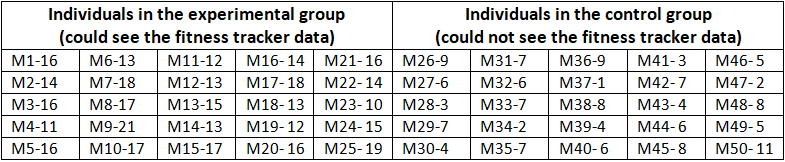
NB: when you enter these data into MINITAB you will need to create two columns of figures, one column for the number of exercise sessions by the male students in the control group (no tracker) and one column for the numbers of exercise sessions by the male students in the experimental group (with a tracker).
Do You Need Assignment of This Question
DATA FOR FEMALE STUDENTS
You recruited 40 female students into the study. All-female students were studying at the University of Reading; all were aged 18-21 years old. All were considered reasonably fit and healthy with no pre-existing health conditions that would prevent exercise. The students were split into two equal-sized groups: (1) those students (N=20) that wore a fitness tracker and could see the data, and (2) those students (N=20) that wore a fitness tracker and could not see the data. Students wore the tracker for the same six-week period during May-June 2017.
During this six-week period, each student was asked to charge their fitness tracker overnight to ensure all exercise was recorded. The fitness tracker would count any incidence where heart rate was about 160bpm for 10 minutes or more as “an exercise session”. The number of exercise sessions recorded are summarised below (e.g. Female student #1 recorded7exercise sessions in the six-week period, whereas Female subject #40 recorded 10exercise sessions in the same period):
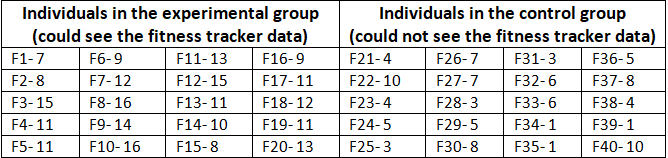
NB: when you enter these data into MINITAB you will need to create two columns of figures, one column for the number of exercise sessions by the female students in the control group (no tracker) and one column for the number of exercise sessions by the female students in the experimental group (with a tracker).
Buy Answer of This Assessment & Raise Your Grades
If you need a native expert Assignment writer, who writes your assignment at cheap prices then this is the perfect place for you because our all online assignment writers have years of experience they write 100% Plagiarism Free assignments according to your university requirements.
Shared with

Answer