
- MLA603 Maritime Regulation & Governance Assignment Information 2026 | MLA College
- ILM Unit 507 Understanding the Organisational Environment Assessment 2026
- Advanced Management Accounting Assessment Information 2026 | University of Salford
- GEOG20091 Sustainability Formative Assessment Brief 2026 | Nottingham Trent University
- 6BM500 Business Psychology Assessment Brief 2026 | University of Derby
- MS1S463 Problem Solving for Computing Assessment Brief 2026 | USW
- HWSC5005 Applied Research in Practice Assignment Brief 2026 | OBU
- Qualifi Level 7 Unit 724 Development as a Strategic Manager Assignment Brief 2026
- A6001C17 Advances in Animal Production Science Assignment Brief 2026 | HAU
- SOCI5270 Contemporary Sociological Theory Essay Assessment 2026 | UOK
- 4BE002 The Innovative Business Assignment Brief 2026 | University of Wolverhampton
- CIPD Level 5 5LD01 Support Informal and Self-Directed Learning Assessment Brief 2026
- COM4016 Productivity and Collaboration Tools for Learning and Work Assessment Brief 2026 | Arden University
- CA6060 Financial Decision-Making in Context for Aviation Assignment 2 Question 2026
- NCFE CACHE Level 3 Diploma for Working in the Early Years Sector Assessment Brief 2026
- CRN 63466 / CRN 63467 Statutory Valuation Level 7 Assessment Brief 2026 | USM
- BSM24105 Operations and Project Management Assessment Brief 2026 | RUL
- Professional Communication Assessment 1 Semester 2, 2026 | UGM
- LAW7128 Conflict Resolution in Business Assignment Brief 2026 | BCU
- MLA604 Maritime Operations Assessment Brief Jan 2026 | MLA College
EGR2006M Control Systems Assignment 1 Brief | University of Lincoln
| University | University Of Lincoln (UL) |
| Subject | EGR2006M Control Systems |
EGR2006M Assessed Learning Outcomes
[LO2] Test electrical machines and devices then compare practical and theoretical results and explain the differences
[LO3] Perform control experiments, select appropriate data for analysis and propose a solution to an industrial control problem
[LO4] Plan and manage their time and resources, and make sound judgements based on technical evidence
Struggling with EGR2006M Control Systems Assignment 1?
EGR2006M Assessment Task
This is Assessment 1 and is an individual assignment.
(a) Derive the mathematical model for a 4-wheel vehicle where, for each wheel, the suspension system will follow a double mass-spring-damper system as shown in the figure. Select sophisticated model parameters related to reasonable physical values.
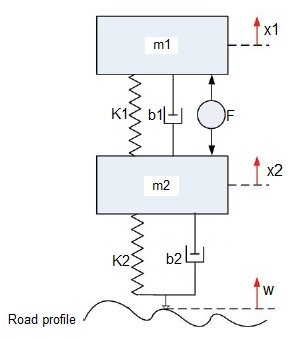
(b) Provide a Control system diagram and analyse the stability of the system for different input signals.
(c) Select the controller for the system and tune its parameters for (i) smooth motions of the car and (ii) the fastest response of the system to external disturbance with overshooting below 20%.
(d) Model system in the Simulink environment and analyse its behaviour, provide plots to support your conclusions
(e) Provide system response for various system excitations (plot the system response at all meaningful points and evaluate key system indicators like rise time, delay, overshoot, settling time, steady-state and transcendent errors):
(i) ramp impact of magnitude between 0.1 and 0.2 m
(ii) single sinusoidal impact on a wheel with magnitude between 0.05m and 0.2m
(iii) repeated sinusoidal impact on a single wheel with constant magnitude between 0.1 and 0.2 m and repeated randomly between 5m and 20m
(iv) random sinusoidal impact at multiple wheels with magnitudes up to 0.2m. Hint: you can have independent system excitations for each wheel
The parameters that are not specified can be assigned a reasonable value at your choice.
(f) Add a PID controller to the system and tune its parameters. Analyse how the system response will change if you use a different controller and prove your conclusions with simulation results for three different input signals of your choice.
(g) Update your system by adding a driver’s seat with an additional suspension system. All physical parameters you can reasonably assign yourself. Provided an extended mathematical model and a control system model. Analyse the response and stability of a new system for different inputs.
(h) Tune the controller parameters to achieve optimal driver comfort. Determine for yourself how to assess the driver comfort. Analyse the system behaviour with and without external disturbance. Here, for external disturbances, you can accommodate up to 3 extra passengers in the car.
(i) Make conclusions on the system performance under different conditions and provide ideas for further system improvements.
Note. Using the same user-defined model parameters across the group will lead to suspicion of plagiarism, which may affect your grading. If you accidentally select the same parameters as another student, this will not affect your grade. To avoid misinterpretation, use the values with 3 significant digits.
Assessment Submission Instructions
This submission is: Individual work
Date for return of mark and feedback
Please see the Hand In Dates.xls spreadsheet.
Note: all marks awarded are provisional until confirmed by the Board of Examiners.
Feedback format
Written feedback will be available on Blackboard.
Use of Artificial Intelligence (AI)
You may not use Artificial Intelligence (AI) in this assignment.
This means that you may not use any AI technologies including Grammarly, CoPilot, QuillBot and others. If you are not sure whether you should be using a particular tool then ask your module coordinator first.
Need Expert Help for Your University of Lincoln Assignments ?
Struggling with your EGR2006M Control Systems Assignment 1? Designing models, tuning PID controllers, and analysing system stability can be complex. Our experts at Students Assignment Help provide custom, 100% human-written solutions tailored to University of Lincoln standards. Get reliable support through university of lincoln assignment help and boost your performance effortlessly. Order your custom assignment answer today and achieve top results with expert guidance.
Answer