
- EGR9017 Power Systems Assessment Coursework 1 Brief 2026 | University of Lincoln
- 7BIOM037W Systems Biology Coursework 1 Report 2026 | University of Westminster
- NCFE CACHE Level 3 Unit 8 Professional Practice Portfolio 1 Coursework 2026
- NCFE CACHE Level 3 Unit 9 Supporting Emergent literacy Coursework 2026
- 6WBS0035/ 6WBS0036 Digital Economy CW1 Assignment Brief 2026 | UOH
- DSM060 Data Science Research Topics Coursework Assignment 2026 | UOL
- BARC0087 Structures Materials & Forming Techniques Coursework 2026 | UCL
- LL5306 Commercial Law Assessment Coursework Brief 2026 | Kingston University
- M22319 / M33098 Numerical Skills & Economics Assessment Coursework | UOP
- BMG872 Global Strategy Development and Implementation Individual Assignment CWK Brief 2026
- LLB020N204A Law of Property Assessment Coursework Brief 2026
- BS3397 Microeconometrics Coursework Assignment Brief 2026 | AU
- UMAD47-15-M Managing Finance Assessment Coursework Brief | UWE
- BST851 Business Data Analytics Assessment Coursework 2026
- MMM143 International Business and the World Economy Coursework 2026
- EMS402U Engineering Design Coursework Project Report 2026 | QMUL
- 25BSC565 Fundamentals of Strategic Management Coursework Brief
- MARK5025 Contemporary Marketing Communications Assessment Coursework Brief 2
- GEEN1127 Design and Materials Individual Coursework Brief 2025-2026 | UOG
- BPS319 PBL 3 Natural Product Chemistry vs Kinetic Isotope Effects Coursework | UOL
The initial part of the coursework is a series of small exercises to compare the FEM analysis with theoretical results for problems: Soil-Structure Interaction Coursework, UOB, UK
| University | University of Bristol (UOB) |
| Subject | Soil-Structure Interaction |
PART 1:
The initial part of the coursework is a series of small exercises to compare the FEM analysis with theoretical results for problems for which the solution is known (see note 1). You should explore the influence of mesh refinement, boundary proximity and boundary fixities as well as loading configuration. If you wish, you may work in a small team and share some results – but please make it clear in your report what is the work of others.
To start with exploring the load-settlement behaviour of a 2-metre wide strip and a 2-metre diameter circular foundation. Each rests on a stratum of stiff clay over bedrock.
Do You Need Assignment of This Question
(i) Undrained bearing capacity
First, calculate by hand the ultimate bearing capacity of a 2-metre wide strip and circular foundations bearing on the surface of stiff clay with soil parameters (design values) shown below. Look up the values of Nc
for a strip and a circular foundation.
Then set up a plane-strain analysis (with 15-node elements) to model the problem below.
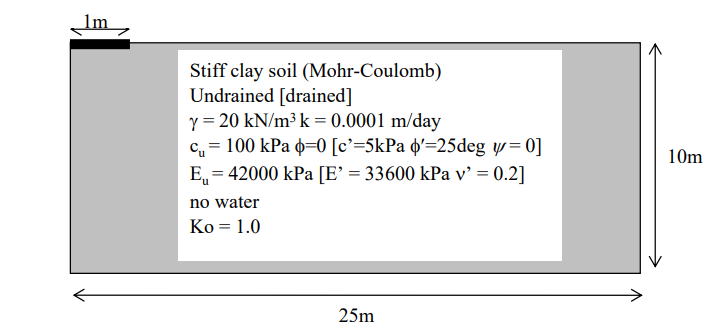
You should model one half of the problem in Plaxis as shown above. The left-hand side of the diagram is an axis of symmetry, and horizontal restraints should be introduced on the two vertical boundaries and vertical and horizontal restraints along the base (default fixities – see note 2). Where the foundation is modelled as a plate explicitly includes a moment restraint on
the centreline (see note 2). Make sure that the mesh is fine enough close to the foundation by refining it several times (refine line or refine point – see note 3) making a note of the number of elements it contains.
Model the soil as an undrained (B) Mohr-Coulomb material, with undrained strength parameters, but using drained stiffness parameters. (Plaxis will convert the stiffness to undrained values).
Model the loading in three ways:
a) apply a vertical displacement of 0.2m (save file e.g. strip1.plx)
b) apply vertical stress of 1000 kPa (save file e.g. strip2.plx) – NB failure should occur
c) include a plate to model a concrete foundation 0.75m thick, again with vertical stress of 1000 kPa (E = 2.4 107 kPa) – (save file e.g. strip3.plx)
(ii) Drained bearing capacity
Repeat the exercise using drained strength parameters. This time place the loading/plate at 0.75m depth to represent a concrete foundation; this is to avoid local bearing capacity failure at the edge of the foundation. Again, look up the values of Nc, Ny and Nq. Compare the results of the FE analysis with your hand calculations. How good is the agreement? See the paper by
Bolton and Lau on Blackboard.
(iii) Settlement analysis
For a flexible strip foundation of width 2m at the surface calculate the settlement at working load (say 150 kPa) using a theoretical solution [e.g. p= (q B /E) x Ip] – see chapter 14 in Lambe and Whitman on Blackboard.
Buy Answer of This Assessment & Raise Your Grades
Get coursework writing help on Soil-Structure Interaction from Students Assignment Help UK.our writers are highly experienced to provide hnd assignment solutions, cipd assignment help, HNC assignment, etc at a cheap price.
Answer