

- NVQ Level 5 Unit 507 Safeguarding in Adult Care Assignment Brief 2026
- EN7068 Leadership, Stakeholders and Data Analytics Coursework Brief 2026
- ENGE2003 Engineering Project Management Coursework 2, 2026 | DMU
- 55-500223 Analogue and Digital Electronic Design Coursework Brief 2026 | SHU
- EGR9017 Power Systems Assessment Coursework 1 Brief 2026 | University of Lincoln
- 7BIOM037W Systems Biology Coursework 1 Report 2026 | University of Westminster
- NCFE CACHE Level 3 Unit 8 Professional Practice Portfolio 1 Coursework 2026
- NCFE CACHE Level 3 Unit 9 Supporting Emergent literacy Coursework 2026
- 6WBS0035/ 6WBS0036 Digital Economy CW1 Assignment Brief 2026 | UOH
- DSM060 Data Science Research Topics Coursework Assignment 2026 | UOL
- BARC0087 Structures Materials & Forming Techniques Coursework 2026 | UCL
- LL5306 Commercial Law Assessment Coursework Brief 2026 | Kingston University
- M22319 / M33098 Numerical Skills & Economics Assessment Coursework | UOP
- BMG872 Global Strategy Development and Implementation Individual Assignment CWK Brief 2026
- LLB020N204A Law of Property Assessment Coursework Brief 2026
- BS3397 Microeconometrics Coursework Assignment Brief 2026 | AU
- UMAD47-15-M Managing Finance Assessment Coursework Brief | UWE
- BST851 Business Data Analytics Assessment Coursework 2026
- MMM143 International Business and the World Economy Coursework 2026
- EMS402U Engineering Design Coursework Project Report 2026 | QMUL
In this part of the coursework, you will determine the mechanism and develop a rate law for a catalytic reaction from experimental data: Advanced Reaction Engineering, Coursework, LSBU, UK
| University | London South Bank University (LSBU) |
| Subject | Advanced Reaction Engineering |
Part 1
Coursework Aim
In this part of the coursework, you will determine the mechanism and develop a rate law for a catalytic reaction from experimental data.
Question 1
Find the rate law for the following catalytic reaction based on the data provided.
𝐴𝐴 → 𝐵𝐵
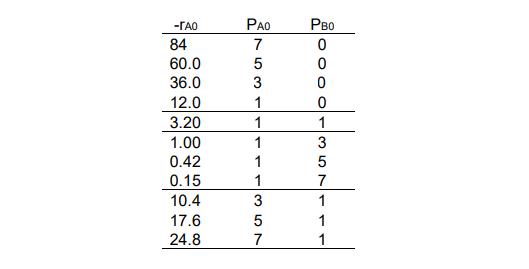
a) Write a full mechanism in the form of a system of reactions describing
adsorption, surface reaction, and desorption. Specify the type of adsorption
mechanism (molecular, dissociative) and reaction mechanism(s) (single site,
dual site, Eley-Rideal) determined to fit the data provided.
b) Determine the rate law(s) for each step (adsorption, surface reaction,
desorption).
c) Find the rate-limiting step and express the rate law in terms of unknown
constants and partial pressures.
d) Solve for unknown constants by fitting the model to the data computationally
(MATLAB is recommended) and then express the rate law solely in terms of
partial pressures. Demonstrate that the model fits the data.
Learning Outcomes
This coursework will fully or partially assess the following learning outcomes for this module.
Knowledge and Understanding
- A knowledge of reactor behaviour for homogeneous and heterogeneous systems. An understanding of reaction engineering so that students can apply the principles to the solution of relevant engineering problems and to the design of reaction processes.
In this coursework, you will use reaction engineering principles to model a heterogeneous catalysis process. This would be the first step towards designing a reactor for this process
Intellectual Skills
- Formulate dynamic material and energy balances to give a good representation of a chemical reactor for simple and complex reactions. Identify mixing and dynamic effects in chemical reactors. Construct models for non-ideal reactors. Make quantitative descriptions of heterogeneous reaction processes.
In this coursework, you will formulate a site balance for a catalyst surface in order to develop a quantitative model of a heterogeneous catalytic reaction process.
- Use a mathematical approach for design, optimisation, and control of chemical reactors.
In this coursework, you will use both symbolic and computational mathematics to develop this quantitative model.
Practical Skills
- Evaluate the performance of chemical reactors. Make provision for heterogeneous processes. Specify temperature profiles. Specify designs for homogeneous and heterogeneous reactors. Optimise reactor performance.
Are You Looking for Answer of This Assignment or Essay
Need assistance with your Advanced Reaction Engineering coursework? Look no further! We offer expert assignment writing help in UK, convenient coursework help online, and specialized assistance with engineering assignments. UK students can easily pay our experts for guidance throughout their courses. Don’t struggle alone—let us help you excel. Contact us today to access expert support and ensure success in your studies.
Answer