
- EGR9017 Power Systems Assessment Coursework 1 Brief 2026 | University of Lincoln
- 7BIOM037W Systems Biology Coursework 1 Report 2026 | University of Westminster
- NCFE CACHE Level 3 Unit 8 Professional Practice Portfolio 1 Coursework 2026
- NCFE CACHE Level 3 Unit 9 Supporting Emergent literacy Coursework 2026
- 6WBS0035/ 6WBS0036 Digital Economy CW1 Assignment Brief 2026 | UOH
- DSM060 Data Science Research Topics Coursework Assignment 2026 | UOL
- BARC0087 Structures Materials & Forming Techniques Coursework 2026 | UCL
- LL5306 Commercial Law Assessment Coursework Brief 2026 | Kingston University
- M22319 / M33098 Numerical Skills & Economics Assessment Coursework | UOP
- BMG872 Global Strategy Development and Implementation Individual Assignment CWK Brief 2026
- LLB020N204A Law of Property Assessment Coursework Brief 2026
- BS3397 Microeconometrics Coursework Assignment Brief 2026 | AU
- UMAD47-15-M Managing Finance Assessment Coursework Brief | UWE
- BST851 Business Data Analytics Assessment Coursework 2026
- MMM143 International Business and the World Economy Coursework 2026
- EMS402U Engineering Design Coursework Project Report 2026 | QMUL
- 25BSC565 Fundamentals of Strategic Management Coursework Brief
- MARK5025 Contemporary Marketing Communications Assessment Coursework Brief 2
- GEEN1127 Design and Materials Individual Coursework Brief 2025-2026 | UOG
- BPS319 PBL 3 Natural Product Chemistry vs Kinetic Isotope Effects Coursework | UOL
6CCE3EAL: Imagine that we have a solid rod, and we apply heat to the rod: for example, by holding it under a flame. Intuitively, we know that if we hold: Engineering Algorithms Coursework, KCL, UK
| University | King's College London (KCL) |
| Subject | 6CCE3EAL: Engineering Algorithms |
Imagine that we have a solid rod, and we apply heat to the rod: for example, by holding it under a flame. Intuitively, we know that if we hold the rod at one end, then eventually we will feel the temperature rising, depending on what the rod is made from: metal rods will heat quickly, whereas a glass rod might not heat at all.
At the molecular level, the ‘hot’ molecules underneath the flame are vibrating rapidly, which causes their adjacent neighbors to also start oscillating. This process repeats, and the further we are from the flame, the more the temperature ‘spread out. If we remove the flame, then the temperature of the rod will eventually decay until it reaches the temperature of the room.
This process is called diffusion. Visually, you can think about adding a small amount of dye to a large container of fluid at rest. Introducing the dye via a syringe at a specific point, we would eventually expect the dye to diffuse amongst the fluid until it can no longer be seen.
To model this mathematically, consider a solid rod of length L and constant cross-section, and assume that the temperature is constant in each cross-section. Then the temperature can be expressed as a function of both one-dimensional location x, where 0 ≤ x ≤ L and time t ≥ 0. We can therefore express the temperature as a function u(x, y). If the thermal conductivity of the material is given by
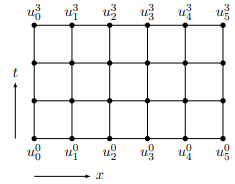
a constant α, then we can show that u observes the partial differential equation.

This is called the heat equation.
To solve the heat equation, we also need some additional information, in the same way, that an ODE needs to know an initial value to give a unique answer. In particular, we need to know two things:
- an initial condition: what is the temperature at t = 0?
- the boundary conditions: what is the temperature at x = 0 and x = L?
For this assignment, we will assume the following:
- the initial temperature is given by some known function f(x), so that u(x, 0) = f(x);
- we fix the temperature at each end of the rod, so that u(0, t) = a and u(L, t) = b, where a and b are constants.
Buy Answer of This Assessment & Raise Your Grades
Students Assignment Help UK is a leading provider of CIPD assignment help. We have a team of experienced writers who are familiar with the CIPD curriculum and can help you with all aspects of your assignment, from research to writing and editing. So if you need online assignment help with CIPD, you’ve come to the right place.
Answer